STORE / COURSES / Introduction to Collections in Housing Finance
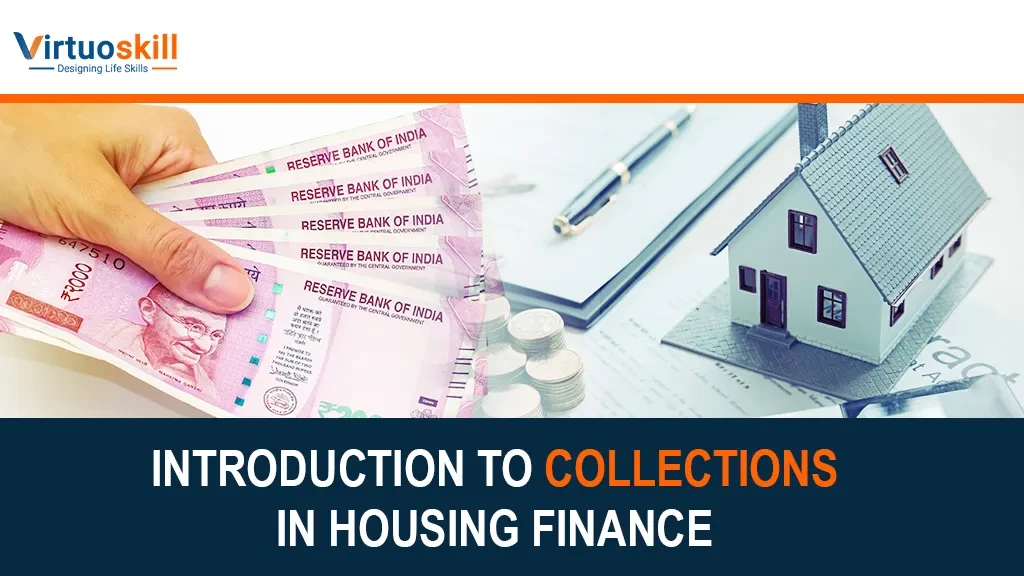
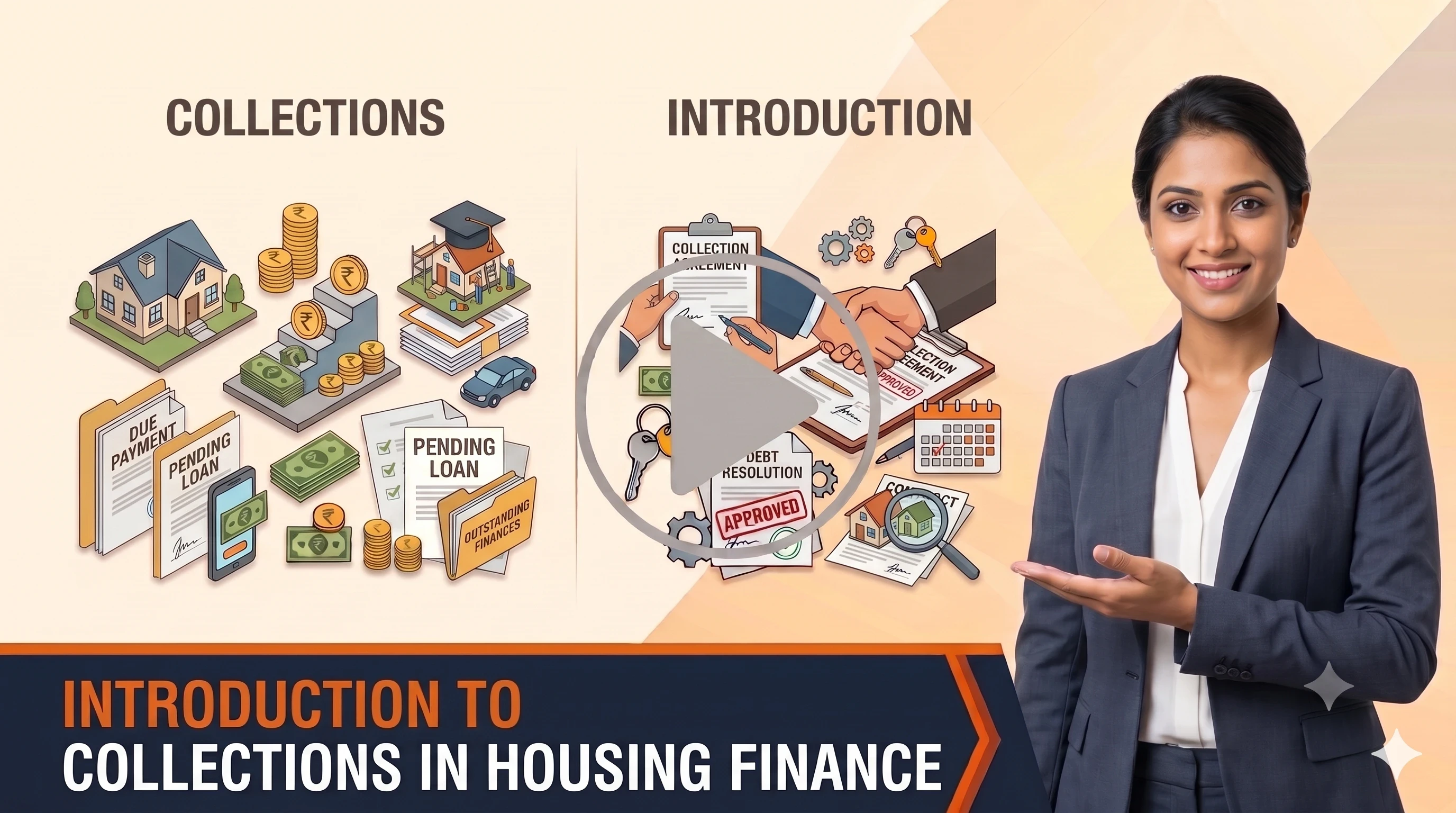
Introduction to Collections in Housing Finance
In this module, we will look at the history of the collections to the role of a bank and the skills required by a collections officer. Collections play an important role in lending of all loans, and it is important to be certified as a professional.
Students and Professionals found this module the right start in the Certified Mortgage Professional (CMP) Program journey

Premium
This course includes:
- Session Time : 63 minutes.
- Engage with the learner Community
- Asking Questions with the faculty
- Videos are available in English & Hindi
- Certificate of Completion (Shareable on LinkedIn)
- Downloadable workbook in pdfs
- Access : Web and Android & IOS Application
- Mobile Access: Downloadable and Offline learning
- This module is also part of CMP program
About
In this module, we will deep dive into the collection process in a lending institution. In banking sector, an institution is evaluated not only top line growth but also on the quality of its portfolio. While the sourcing and the choice of customer segment is important component of the portfolio quality, the role and the skills of collections plays an important role in the success of the institution. Any delay in the collection has an impact on the loan portfolio in terms of provisions to be done having direct bearing on the profits of the lending institution.
The RBI, the central bank of the country has issued circulars on the code of conduct to be followed by collection officers and the field agents of the lending institution to ensure that fair means are adopted in collecting money from the defaulting borrowers.
This module will take you through each stage of collection process.
Overview of the course content:
What you will learn.
- History of Collection
- Role of Collections Department
- The functioning of Collection Department
- Strategies of Debt Collection
- Process of Debt Collection
- Skills need for Collection Officer
- The code of conducts for Collection officer
Explore related topics
Course Outline
| Section 8 | Lessons 31 | Knowledge Test 6 | Final Assessment 01 |
| 01 Introduction to Collection | Lessons 5 | attachment 1 | 3 Trial |
| Preview of the course | Video |
| Introduction | video 2m 13s Attachment Trial |
| History of Collection | 02m 25s Trial |
| Role of Banking | 04m 21s Trial |
| Business Process Flow in a Housing Finance Company | video 02m 13s |
| 02 - Case Study of a Home Loan Borrower | Lessons 7 | Knowledge Test 1 |
| Overview of Home Loan Customer Mr. Vipul | video 2m 16s |
| Understanding of Equitable Mortgage | video 2m 14s |
| Post-Disbursement Welcome Call to | video 01m 10s |
| Demo of a Welcome Call | video 1m 48s |
| Concept of Repayment cycle | video 01m 50s |
| Default Scenarios & Case Facts | video 1m 21s |
| Recap | video 00m 38s |
| knowledge Test |
| 03 - Role of Collection Department | Lessons 5 | Knowledge Test 1 |
| Importance of Collection Department | video 6m 5s |
| Collection Model in a Financial Institution | video 1m 20s |
| Functions of a Collection Team | video 03m 50s |
| Structure and Mode of a Collection Team | video 2m 44s |
| Recap | video 00m 32s |
| Knowledge Test |
| 04 - Regulatory Norms Applicable for a Lending Institution | Lessons 4 | Knowledge Test 1 |
| Impact of Regulatory Norms & Asset Classification | video 4m 19s |
| Case Study of Mr Nitin Rao to Understand Regulatory Norm | video 2m 2s |
| Provisioning Norms & Case Study | video 06m 27s |
| Recap | video 00m 26s |
| Knowledge Test |
| 05 -Strategies for Debt Collection and Delinquency Management | Lessons 3 |
| Concept of DPD & Buckets | video 2m 36s |
| Scenarios to Understand DPD and Buckets | video 1m 52s |
| Recap | video 00m 52s |
| 06 - Skills for Collection | Lessons 2 | Knowledge Test 1 |
| Skills Needed for Collection | video 2m 18s |
| Recap | video 00m 41s |
| knowledge Test |
| 07 - Debt Collection Process | Lessons 3 | Knowledge Test 1 |
| Approach to Debt Collection | video 03m 14s |
| Soft and Hard Approach to Collection | video 03m 09s |
| Recap | video 00m 26s |
| knowledge Test |
| 08 - Code of Conducts for Collections | Lessons 2 | Knowledge Test 1 |
| Code of Conducts | video 03m 24s |
| Recap | video 01m 9s |
| knowledge Test |
| 09 - Assessment-Introduction to Collections in Housing Finance | Final Assessment 01 |
Who should enrol for this course?
This is suitable for an individual, be it a college student or a professional from the wide spectrum of the BFSI sector aspiring to work in a retail bank as a Sales, Operations, Credit/ Operations Risk, Collections, Legal and Technical role. This module is also suitable for professionals working in the retail banking industry with 1-15 years of work experience.
This module will be very good for students and professionals working or intending to work as an independent Certified Financial Planner, Insurance Advisors or Direct Sales Associate (DSA), Connectors, Business Associate in the domain of retail loans.
This module is also recommended to individuals having taken or proposing to take retail loans as a customer of a Bank, NBFCs or HFCs, or Microfinance institution.
Total Time:
The module is 63 minutes.
Total time required for this course would be nearly 63 minutes. The entire course has been divided into smaller micro learning modules. You can even complete micro modules of 05 to 20 minutes at your convenience. We recommend you allot good time to recap your learnings.
The Mode of Delivery:
To make it simple and easy to understand, the course will be delivered as video-based module with voice over in English to assist learners. We have designed this course spread over various segments followed by a knowledge test and a quiz at the end.
You will be asked to download a workbook at the beginning of the module. Do remember to download and take notes and list down your questions that you may want to ask the facilitators of the course.
To make it easy, we have two sections in every frame of the video.
The first is discussion board. It is a community of learners, where you can raise your questions that may be answered by one of the learners or by the facilitators for the course. It is possible that your questions may have been raised already by a learner and you can see trail of the discussion and concluding comments by the facilitator.
The second is a section for taking notes. This is an online space for you to take notes of your learnings or important points that you want to recall. You must remember to download or copy the same to your note pad or a word document before expiry of the course for which you may have been enrolled.
Evaluation Process:
At the end of the course, you will have an “Online Test” for being certified as proficient in the course on getting minimum of 60% and above.
You should identify yourself on the following scale.
Score of 90% plus – Maestro
Score of 70 - 90% - Expert
Score of 50 - 70% - Professional
Score of less than 50% - Try again
You will get a certificate that can be downloaded for your records. We encourage you to share your proficiency on the social media especially in LinkedIn, Instagram and Facebook to showcase your competency amongst our peer group. This will help you to build professional competency profile.
Wish you all the best!
Review & Rating
⭐ 4.9
64 ratings
''Very useful information even a sales guy, must read module .''
 Ashwini Kumar
''Very Good for Collection .''
Amit Sharma
"Easy To Understand."
 Sathish Kumar SM
Review & Rating
⭐ 4.9
64 ratings
''Very useful information even a sales guy, must read module .''
Ashwini Kumar
''Very Good for Collection .''
Amit Sharma
"Easy To Understand."
Sathish Kumar SM
Students also bought

Students also bought